

You never know what you’ll find in the subway. Above, one of the columns on the Brooklyn-bound platform of the R train at Whitehall Street, supporting the station roof, some twenty feet of soil, and the street above. The station opened in 1918 as part of the Dual Contracts system, and was built a year or two earlier.
Unlike the columns in a building, this one ends rather abruptly at the top of the picture. The girder it supports runs over the top of the column, and the girder supports the concrete arched vaults and steel filler beams that make up the station roof. The plate at the top of the column is a bearing plate for the girder, and the bracket on the web of the column is to provide better support for that plate. There’s something a little funny at the top of the bracket:
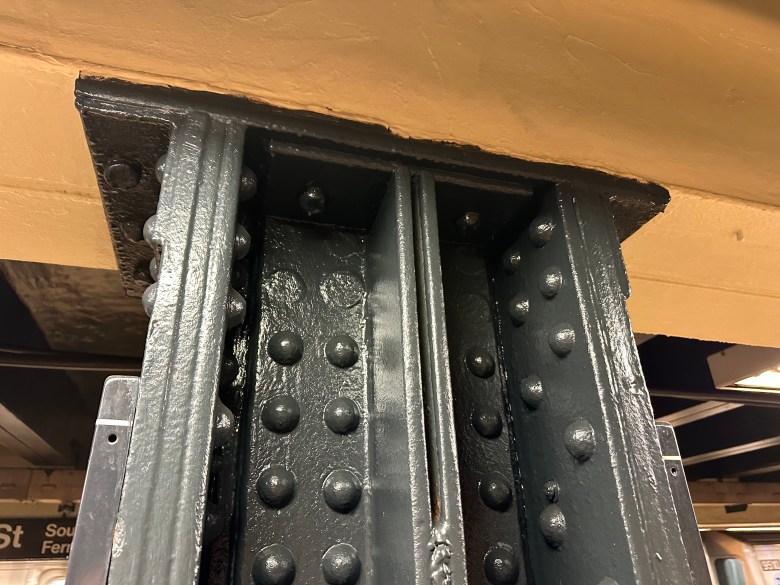
Those lines of rivets are the connection between the angles that make up the bracket to the column web plates and the angles that make up part of the column flanges. The top two rows of rivets do not have the standard half-sphere heads, but rather are larger in diameter and almost flat. This could be some bad alteration, but it’s not. Those rivets have flat countersunk heads, which are not as stong as regular heads but good enough in this application (where there is little tension on the rivets but a lot of shear). The countersunk head take more work both in preparing the hole in the steel material and in driving the rivet, and spending more effort for a weaker result seems like a bad idea unless there’s a good reason. In this case, the reason is constuctibility: the art/science/magic of making sure that something that can be drawn can actually be assembled on site.
The built-up column would have been fully fabricated in the shop and brought out to the site as one piece including the brackets. It was set in place and then the girder was set on top of it. Those two vertical rivets between the bracket and the girder bottom flange (and the two on the far side of the column on the other bracket) had to be driven in the field. Rivets came with one head already pre-formed, and after the rivet was set, red-hot, into place, the shank was beaten down with a pneumatic hammer to form the other head. During the process, the pre-fromed head was held in place with a tool to keep it from moving. So either the hammer or the holding tool had to be able to reach those vertically-oriented rivets as they were installed…so the adjacent rivets for the bracket have countersunk heads to get them out of the way.
You must be logged in to post a comment.