

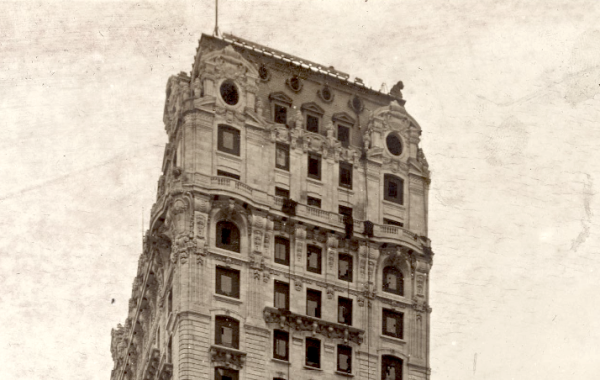
In the course of doing research on old buildings, I’ve looked at some non-traditional sources. For example, in trying to find original images of demolished and non-famous buildings, I’ve had some success with magazine ads from tenants. It used to be popular to put a picture of the building where a business was located in an ad, and while those pictures cannot be assumed to be completely accurate, they may be the only image you can find of a building demolished in the 1910s. In that context, I have recently started reading through the Bridgemen’s Magazine, a journal published by the International Association of Bridge and Structural Iron Workers. Most of it is devoted, as you’d expect, to union business, but there are some quite detailed technical articles. For example: “A 40-Story Building In New York City” published in October 1906 about the design of the Singer Building.

To give a sense of it:
There are, in the plan, eleven panels of wind bracing in a northerly and southerly direction in the tower, and ten panels in the other direction. The tower columns are 12 ft. on centers, and are connected in both directions by lines of 12-in. I-beam girders, doubled or reinforced by channels in those places where they serve as wind braces in addition to carrying floors. The girders support 8-in. floor I-beams, and each floor is enclosed by an exterior rectangle consisting in part of 20-in. I-beams and part of the wind bracing, which gives it additional stiffness and carries the walls.
This is quite similar to the descriptions you’ll find in the Engineering News or the Engineering Record,
and with good reason. The steelworkers knew that their value to the building process lay in their expertise. This is a good place to point out that the first generation of steel-workers in buildings, like the first generation of structural engineers, came from the world of truss bridges. The name of the journal and the union is not a curiosity but rather a straightforward statement of who they were.
Note: in the January 1905 photo above, the Singer Building is behind the City Investing Building, also under construction. The wide white facade is City Investing; the narrow darker facade is Singer.
You must be logged in to post a comment.