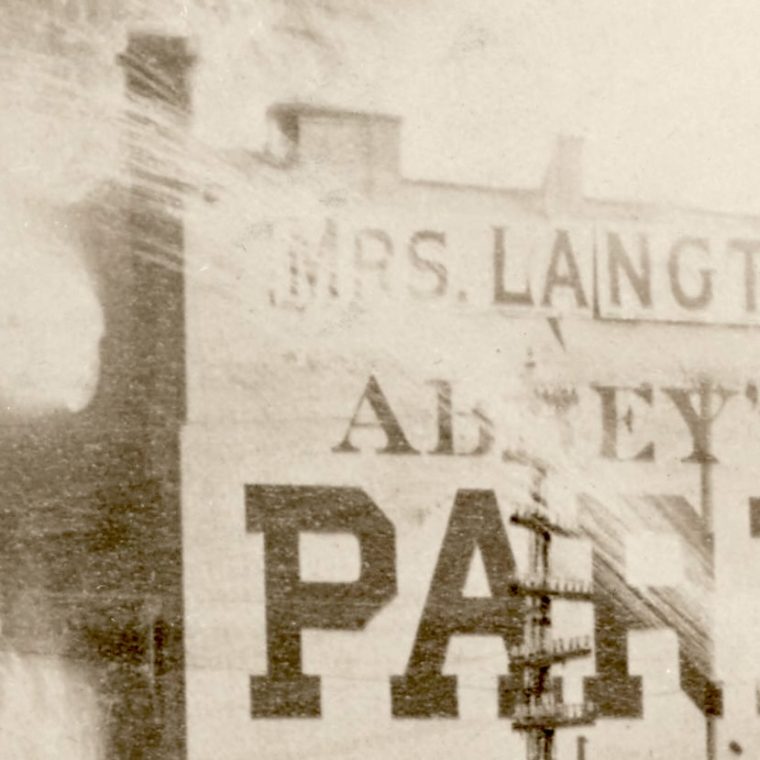

Theater fires were among the worst building-related events of the nineteenth and early-twentieth centuries in the US. The Iroquois Theater fire in Chicago killed over 600 people; closer to home, the Brooklyn Theater fire killed about 280. I serious do not recommend reading about these events unless you’re sure that the descriptions won’t bother you. The picture below is from a scrapbook at the New York Public Library, where it’s titled “Burning of Abbey’s Park Theatre, New York.”

The photo appears to have bene retouched: those are awfully artistic flames. It’s entirely possible, given the state of photogrpahy in 1882, that this is a photo of the theater retouched to add all of the flames.
I had never heard of the theater or the fire, which took place in 1882, six years after the horror in Brooklyn. This was a serious theater a block from Madison Square at the time when that was the entertainment center of the city; the temporary sign above the theater’s name tells of Mr. Abbey’s marketing coup: Lilly Langtry was due to open there the same day as the fire.
The reason I never heard of it is in the newspaper accounts: there were two or three deaths. The fire started in the afternoon, before the audience had entered, and the relatively small number of stage hands had an easier time getting out than a large crowd would have. Wood-structure theater buildings – even with “fireproof” masonry exteriors – filled with wood, cloth, and paper decorations, with gas and lime lighting, and with few interior partitions to slow flame spread were seemingly designed to burn. The investigation of the Abbey’s Park fire showed, again, that once a fire started in a building like this, it was near impossible to stop. What finally ended this kind of event was the change to non-flammable structure and electric lighting; what ended the huge death tolls in theater fires was improved egress requirements and, eventually, sprinklering.

You must be logged in to post a comment.