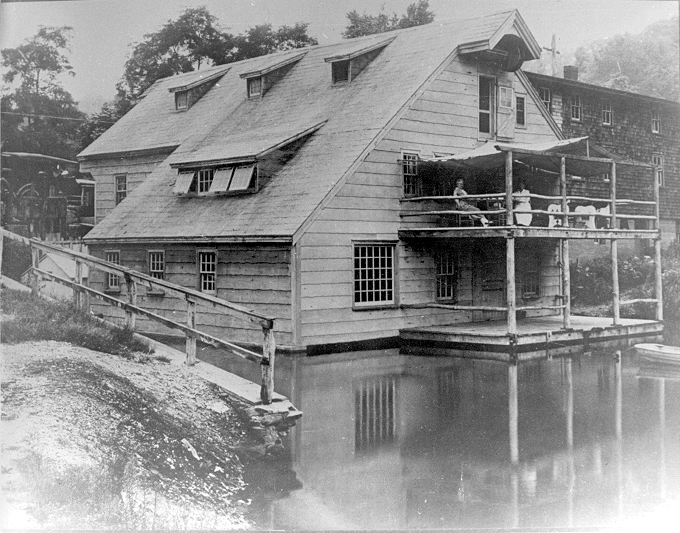

Sometimes, very old buildings gain glamor as they age. Another of our pre-Revolution projects with John G. Waite Associates, Architects is the Roslyn Grist Mill, an industrial building from the early eighteenth century that has somehow become glamorous over time.

A grist mill grinds grain, and needs a source of power to turn its wheels. At the town of Roslyn, on Long Island, there’s a stream- and spring-fed pond south of the mill (and south of the original line of the road that used to be Northern Boulevard until that got moved north and turned into a highway) that drains downhill north to Hempstead Harbor and the Long Island Sound. The drop in elevation from the pond to the harbor allowed for easy construction of an overshot waterwheel, and plenty of power. The heavy-timber and overlapping-clapboard mill operated as such from the 1740s (or maybe earlier) into the early 1900s. It was then turned into a restaurant – a tea house – from the 1920s to the 1970s, and has sat vacant since.
At some point, the street in front of the building was raised, presumably to reduce the grade at the sloping intersections on either end, and also to lessen the likelihood of flooding. This left the mill – a two-story building with an attic – with only its roof and a bit of the upper floor visible from the street. Part of the current restoration project was to raise the building to restore its original relationship to the street; the rest is mostly intricate repairs to damaged timbers, led by Jan Lewandoski.
Part 1, Fraunces Tavern: here.
Part 2, St. Paul’s Chapel: here.
Part 3, Fort Ticonderoga: here.
Part 4, Philipse Manor Hall: here.
Part 5: Vander Ende-Onderdonk House: here.
Like this? Then read the “Witnessing the Revolution” series by Cirrus Structural Engineering

You must be logged in to post a comment.