

The New York County Courthouse, on Chambers Street, in 1870:
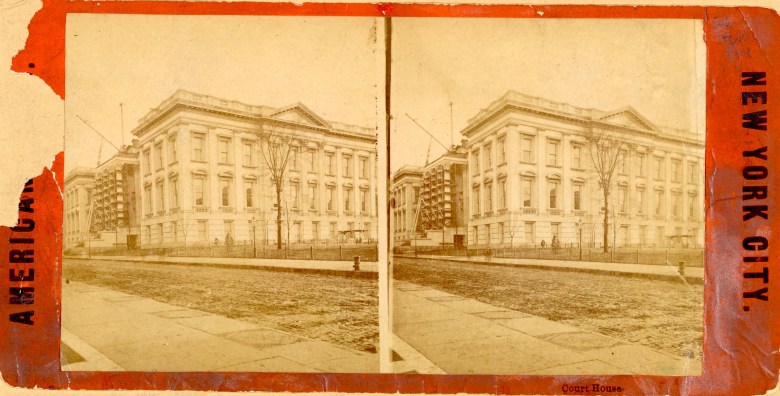
The building is much better known as the Tweed Courthouse, but I’ll assume for a moment that people reading this don’t know why. The photo is best explained by discussing a sequence of events:
1851: William Tweed was elected to the New York City Board of Aldermen. That was the forerunner of the current local legislature, the City Council.
1857: Tweed was elected to the New York County Board of Supervisors. That was a now-defunct piece of government, from the days when the actual city was much smaller than New York County (in area, not population), and the county was still technically in charge of long-term planning for infrastructure.
1861: Construction began on a much-needed new county courthouse, organized by the Board of Supervisors. From the beginning of the project, it served as a vehicle for theft by Tweed and his associates (the “Tweed Ring”) through an amazingly simple scheme: contractors would submit inflated bills (often many multiples of the actual cost) for actual work. They would be paid in full, with the excess being kicked back to the Ring members.
1865: The exterior shell was largely complete, but the interior was not.
1866: The thievery was publicly discussed and investigated for the first time. Nothing changed.
1867: The first occupancy of the still-unfinished building began.
1869: The peak of the Ring’s power. The governor of New York State, the Mayor of New York City, and the city’s comptroller were all Ring members or allies; Tweed was the city’s Commissioner of Public Works.
1870: The picture above was taken. The entrance portico, facing Chambers Street, would not be completed for another six or seven years.
1871: A county auditor, who moonlighted keeping the off-the-books books for the Ring, died in an accident. His records eventually ended up in the hands of reformer.
1871: Reporters at the New York Times began publishing articles on the findings; Thomas Nast at Harper’s Weekly began publishing editorial cartoons on the findings. Tweed said of Nast’s work “Stop them damned pictures. I don’t care so much what the papers say about me. My constituents don’t know how to read, but they can’t help seeing them damned pictures!”

1871: Tweed was arrested and many of the Ring members left government, the city, and sometimes the country.
1871: Work on the courthouse stopped. John Ketchum, the original architect, died. At that time, $11,000,000 (around $290,000,000 in 2025 dollars) had been spent on the unfinished building.
1871: Tweed was convicted and sentenced to one year in prison and a relatively small fine.
1872: Tweed was released from jail and then sued by the state in an attempt to recover roughly half of the stolen money.
1873: Tweed was jailed for lack of money for bail in the civil suit.
1875: Tweed escaped and fled to Spain. He was identified by Spanish authorities using a Nast cartoon, and re-arrested.
1876: Tweed was returned to jail in New York.
1876: Leopold Eidlitz was hired to expand and complete the courthouse.
1878: Tweed died in prison.
1881: The courthouse was completed.
1974: The courthouse was added to the National Register of Historic Places.
1984: The courthouse was designated as a New York City landmark.
1991-2001: the courthouse was thoroughly restored.

You must be logged in to post a comment.