
Sidewalk sheds of various types have been used in Manhattan since the 1890s, maybe earlier. The idea is simple: you need to protect people against objects falling off of construction sites, and buildings in Manhattan are typically at or very close to the sidewalk lot lines. In less-crowded cities you can put up a fence and keep people away from the building, but at most Manhattan construction sites, the fence would be literally against the building.
A sidewalk shed is, traditionally, the same width as the sidewalk. If you close a lane of the street you could theoretically put the outboard posts there, but (a) closing a lane is always fraught and (b) those posts would be vulnerable to traffic impact and protecting them becomes another design problem. I’ve seen this done, but very rarely. Of course if the sidewalk is narrow, the street is now in the potential impact zone for falling objects and a shed over the sidewalk isn’t proving any protection. One solution, which I know was used as early as 1910, is to simply put in a shed that covers both the sidewalk and the street, and sometimes the far sidewalk for good measure. If you think about the construction of skyscrapers around Wall Street 1890-1920, this makes sense, as many of the streets in the area were laid out in the 1600s and are laughably narrow.
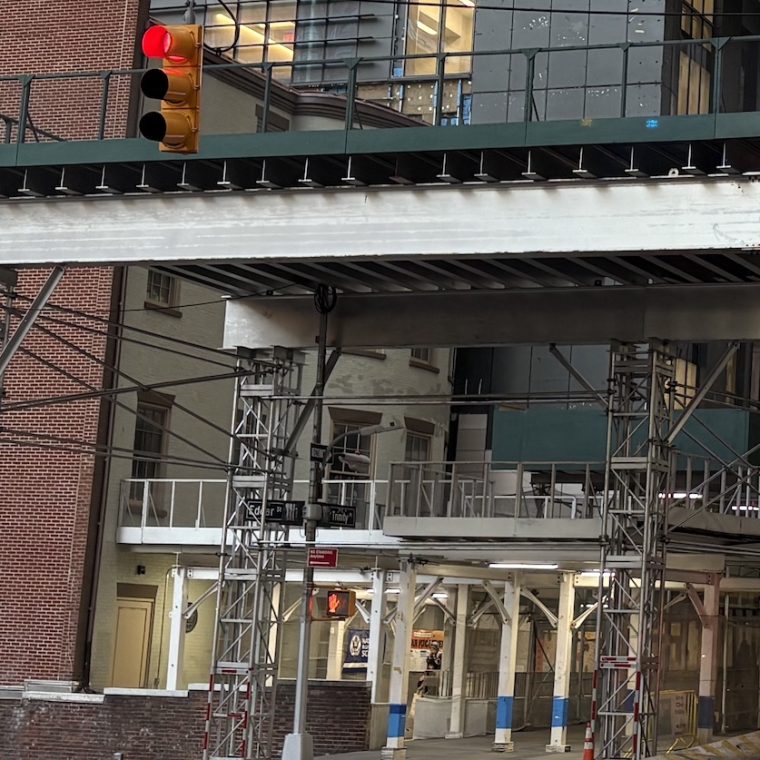
In any case, here’s an example in a photo from a couple of weeks ago:

Note that the shed actually spans two streets: Trinity Place (the street I was standing on) and Edgar Street on the left. The trussed posts supporting the left side of the shed, next to the building being worked on, have jersey barriers to protect them from vehicle impact. This is not a cheap or easy solution, but it is a safe one, when circumstances require it.


You must be logged in to post a comment.