
I wrote recently about how the passing of the Adams administration’s ‘City of Yes’ proposal would reform zoning laws to bring office buildings from 1960 to 1990 into the fold for conversion to residences.
Within the wider conversation around office-to-residential, I see this bringing attention back to the host of structural challenges developers need to be aware of when approaching a conversion.
The scale of the problem
Manhattan offices from the 1900s to 1930s are mostly now considered to be Class B buildings. In many ways, these would be prime for conversion because they lack the big open floors of more modern buildings, but people like them for offices – our office at Old Structures is an example. Instead, it’s the expansive, early-modern 1960s and 1970s buildings that owners don’t know what to do with, and those are specifically the type affected by the City of Yes zoning reform.
Outdated systems in these buildings, like mechanical ventilation and air-conditioning, and fluorescent lights, require expensive overhauls to keep them as desirable Class A buildings. If the buildings need to be stripped down to the bare structure to keep them up to date – and even that structure will need to be modified – then other options become economically feasible.
It’s easy to see why converting the 60s and 70s buildings for residential starts to become more worthwhile for the owners in order to appeal to buyers and command the rent they want. However, conversion of any kind requires an understanding of the many nuances of Manhattan office buildings over the years. For these early-modern buildings, there is the architectural challenge posed by windows up to 60 feet away from the core of the building while, by comparison, the abundance of windows in older offices make them more easily convertible to residential spaces with a lot of natural light.
Offices through the ages
Very Old: Pre-1895
These buildings are characterized by heavy bearing walls and almost all have masonry vault floors.
Those still standing, for example the Washington Building at 1 Broadway (1882), have likely been renovated many times.

Old: 1890-1920
Buildings like the Bowling Green Offices at 11 Broadway (1896) used the first generation of steel frames with brick curtain walls.
They have oddball floor structures, like terracotta tile-arch floors and draped-mesh floors – and we have a lot of expertise in dealing with floors like these.

Semi-Modern: 1920-1955
Steel-framed buildings like the Irving Trust Company at 1 Wall Street (1931) are much closer to modern construction, but with mostly draped-mesh floors and early kinds of stick and panel curtain walls.

More-or-Less Modern: 1950-1990
The mid-50s saw the arrival of concrete frames, metal decks and uninsulated curtain walls, a good example being the Union Carbide Building at 270 Park Avenue (1960).
Walls of this type are terribly inefficient when it comes to heat retention, making upgrades necessary whether they remain offices or not. And the original mechanical systems, if present, don’t meet modern standards for efficiency.

Each of these eras saw the use of novel structural techniques, which have unfortunately made many older buildings a headache for today’s developers to convert.
Getting to grips with unusual structures
In Manhattan, we have some extraordinarily peculiar floors used in steel frame buildings from the 1890s into the 1930s, all kinds of which we’ve had experience with at Old Structures. These are floor structures that don’t meet current code, and unless contractors have already encountered them, they might be left baffled.
Draped mesh floors are a prime example – while these were supposed to use a form of concrete with anthracite coal cinders as aggregate, in many cases they instead used bituminous coal cinders (containing sulfur) as a shortcut. The result was that plumbing leaks often led to a chemical reaction producing sulfuric acid, corroding the steel wires used in the mesh – we’ve repaired a lot of these floors.
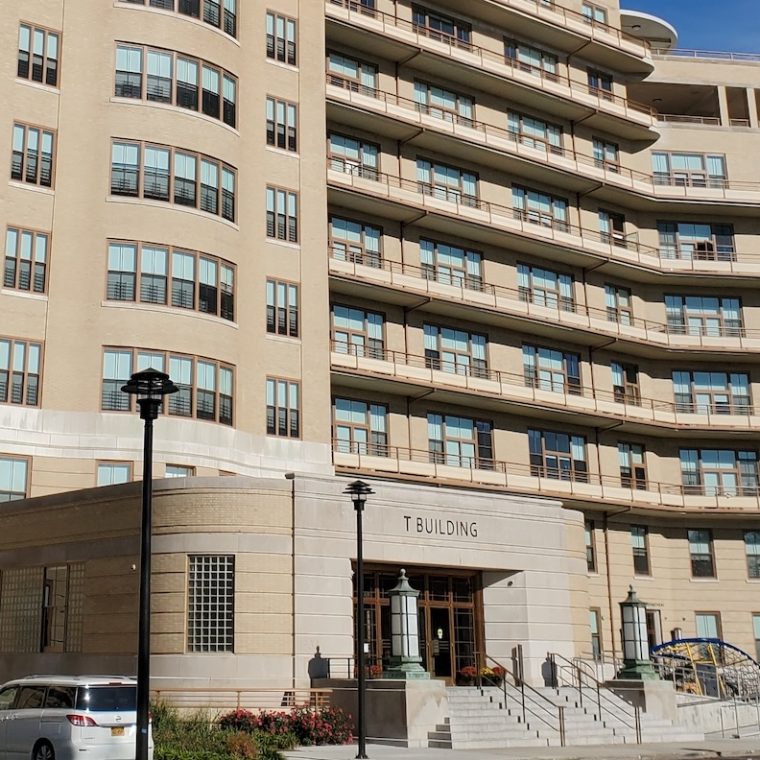
Another issue we’ve encountered in converting buildings with peculiar floors is when holes are bored for plumbing or ducts, which end up going right through key parts of the floor structure. We saw this during our work on the T Building project, where some of the concrete ribs had been damaged during plumbing work and required our intervention to avoid further structural damage.

In an office building with two-way concrete slab flooring, like those built starting in the 1970s, removing portions to construct light courts or elevator shafts will break continuity in the remaining adjacent portions of slab, often requiring steel beams to be added for reinforcement.
Older types of facades can also bring challenges for an office-to-residential conversion. Masonry, glass, or metal curtain walls fail to meet modern energy code and require insulation that can change weight distribution. Many older walls also may lack continuity and be designed for too-low wind pressure.Additionally, none were designed for seismic load, which is now in the code and which will be necessary at certain levels of alteration.
This applies to frames as well – large amounts of alteration to older buildings, such as adding floors or infilling courtyards, change load patterns and can result in having to meet modern structural standards for seismic and wind load.
Addressing the challenge
In many cases, potential issues with these older structural elements are left unknown until work has already begun, which leads to problems further down the line that aren’t necessarily budgeted for. Projects may have zero budget allocated for structural repair work, and may have unrealistic assumptions about cost based on modern structural materials. This kind of oversight can result in needing to source additional funding for the repairs after the project has started.
Ideally, projects would bring a structural engineer on board as early as possible in an office-to-residential conversion. This would allow them to identify these structural quirks and provide creative solutions to achieve the architectural vision as closely as possible. The reality is, unfortunately, that people may not realize the kind of constraints on design that the existing structure creates, and may establish project goals long before a structural engineer is involved. For buildings like those I’ve mentioned above, this can be the difference between a smooth conversion and millions of dollars worth of structural repairs.
Bringing in structural engineering expertise
In our experience dealing with conversions of older buildings at Old Structures, we’ve always found that the earlier a structural engineering perspective is involved in the conversation, the better the outcomes. Performing a structural survey early can identify constraints for the design and construction team, so developers and architects can understand the cost and impact of working around these. Adapting schematic design around these constraints can also lead to a potentially faster construction turnaround and a more architecturally interesting project.
For any developers considering an office-to-residential conversion of an older building, speaking to a structural engineer early can help you explore different options for fitting the design better into the limitations and quirks of the existing structure.
If you’re interested in office-to-residential conversion or just want to find out more, we’d love to discuss our approach with you. Get in touch.

You must be logged in to post a comment.