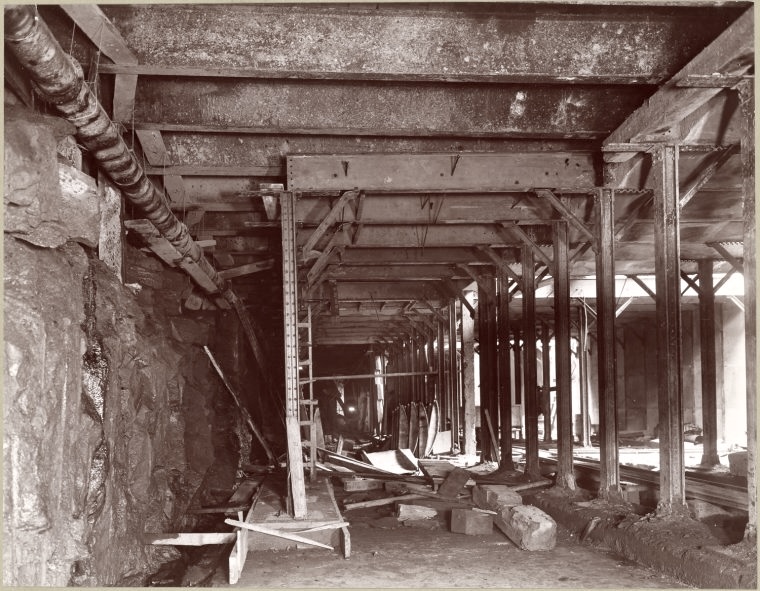

The New York Public Library has a small group of images of construction of the IRT subway, and they’re worth a look. They cover the original line, which opened in 1904, and the immediately-following extensions (Brooklyn and Lenox Avenue), so they’re from 1901 to 1905, as stated at the NYPL site, but a few might be as late as 1907 or 1908.
Here’s “Construction of Subway System”:

There’s a lot going on there. So much so, that I think a labelled version is better:

The IRT was built cut and cover wherever possible, which was most of the line. Later this week I’ll go over some photos of areas where it was built using tunneling. In this photo, the sunlight on the right is an area where there was no temporary roof over the cut. (In this photo, the permanent roof slab has not yet been built.)
We know we’re in a tunnel area and not a station because of the small and closely-spaced columns (C). The tunnel column spacing in the early IRT was 5 feet, increased to 10 and 15 feet at the stations. I’m not sure which part of the system this was taken in, but it’s one where they were chopping rock (B) to make the cut, and there is no lagging or other earth support used.
The temporary roof beams (A) are carrying a temporary street made of wood plank over the cut. Those are some big wood beams, supported on a temporary wood girder (F) that is supported on the permanent columns below. It looks like the columns between the tracks (on the right) were erected first, and as the columns at the edge of the tunnel (left) are erected, the permanent roof beams (D) are being erected at the same time. If you compare F and D you’ll see that part of the permanent beam to column connection seems to have come to the site with the center columns. After the permanent roof beams were erected, the braces (E) were riveted to them and to the columns.
One minor and interest artifact of supporting the temporary roof on the same columns as the permanent roof: note that the slope of A and D are different. The temporary beams A, presumably, more or less follow the slope of the street as set by the buildings on either side; the permanent beams do not have to do so because they will support a concrete roof and then earth fill below the street paving. The street seems to be sloping from left to right; the tunnel is not.
You must be logged in to post a comment.