
Some more pictures from that 1890s church, specifically looking at where the roof trusses bear on the masonry walls. First, an overall view (all photos by Ellen) to show the various pieces:

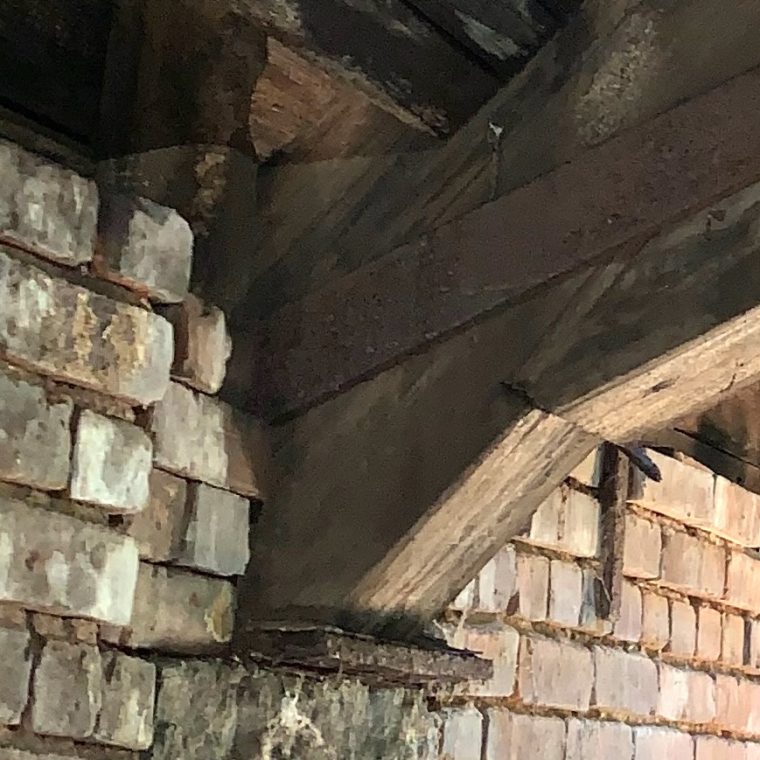
This is the first truss from the end wall and we have the diagonal V of the top and bottom chords of the scissors truss running from upper right to lower left, where the truss meets the wall. The lowest purlin for the roof is seen connecting to the top chord just above its base. The span of that purlin on the far side of the truss has been resupported at its midspan with a steel bracket mounted on the wall. The truss rests on an iron baseplate, which rests on a granite block. Finally, there’s an iron strap bolted to the side of the lower chord.
The detail I want to focus on is what happens where the truss meets the wall. Here’s a close-up, looking into the wall:

The brown thing running from dead center to the upper half of the right side is the iron strap, used to connect both chord to the masonry as a tie-down and to provide some lateral stability. The gray right below that is the top chord; the end of the bottom chord is the small gray triangle on the far right, near the bottom of the photo. You can see clearly here how the top chord is sitting – bearing – on the iron plate, which sits on top of the granite block set into the brick masonry. One more view, with Tim as an accidental subject in Ellen’s photo:

That granite block is slightly more than 4 courses of brick high and, as can be seen in the second photo, extends most of the way through the wall. The presence of that block is not an accident: part of section 481 of the 1887 New York City Building Code reads: “In any case where any iron lintel, or iron or wooden girder, column or post rests on any wall or pier built entirely of stone or brick, the said lintel, girder, column or post shall rest or be set on a base stone of cut granite, or blue stone, at least twelve inches thick, or an iron plate of equal strength, or both combined, of such thickness as may be necessary to properly transmit the weight above.” In other words, the code required a hard stone block to protect the brick (hard, but softer than granite or bluestone) from the concentrated load of a beam, post, or (implied) truss. An iron plate is harder still, but unless it is very thick it will be more flexible than a stone block, which defeats the purpose of creating an even bearing pressure across the brick below.
If I were constructing this particular building, I’d use the combination iron-plate-on-granite-block because it provides some geometric flexibility. The stone should be set entirely within the brick, but the plate can project out a bit, allowing for less-than-perfect placement of the wood trusses.

You must be logged in to post a comment.