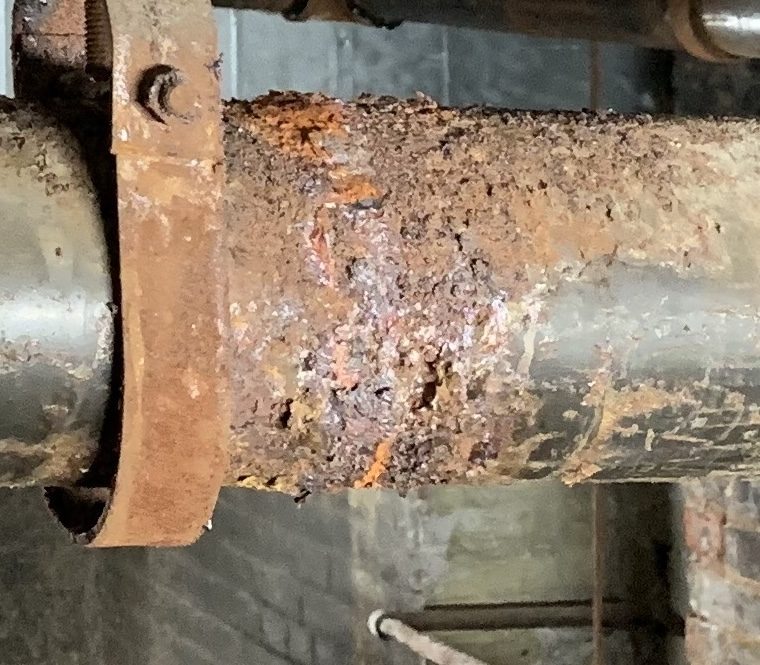

One of the ways in which wood damage can be different from damage to other materials is that the damage caused by biology attack can spread by itself. Wood-eating bugs and rot fungi can spread to wood that was fine before, and they have to be definitely killed to be got rid of. Masonry weathering or steel rusting, on the other hand, don’t spread beyond the presence of water. Perfectly good steel, just waiting to rust, won’t, even it’s a few inches from steel that is rusting. So this picture requires a little explanation:

First, this is a sidewalk vault – one with an unusually high ceiling because it originally housed a boiler – so above those brick vaults is the concrete sidewalk of a Manhattan street. You can see where water has made its way through the (not waterproof) concrete and the (not waterproof) masonry to cause efflorescence at the mortar joints. But, of course, what grabs your attention is the condition of the beam supporting the vaults. I don’t remember the age of the building, which would give a hint as to whether that’s wrought iron or steel. The delaminated rust looks like steel, but wrought iron can give a pretty similar appearance. The fittings for the pipe hanger are rusted, and there’s a band of rust on the pipe itself. Water trickles down, right?
But…the rust on the pipe is pretty evenly distributed from top to bottom, which is quite odd. Water does trickle down, and I’d expect the pipe, if it were rusting from water dripping off the beam above, to be most heavily rusted at the bottom, where water would run along the curved pipe surface. I think most of what we’re seeing here is rust that has flaked off the beam and fallen onto the pipe sticking to the surface of the pipe. It’s rust doing the thing that rust isn’t supposed to do, spreading by itself. This is actually good news, as it means the pipe isn’t badly damaged, just dirty. Not necessarily all – there may be some actual damage to the pipe.
You must be logged in to post a comment.