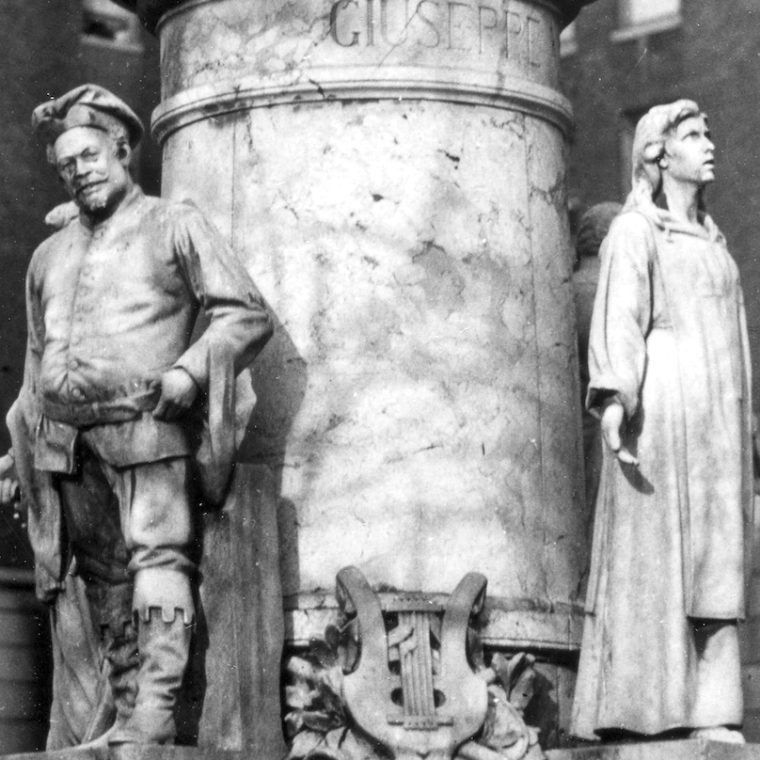

One of my weirder old projects…The Verdi Monument at Verdi Square, which is the narrow triangle[1] bounded by Broadway on the west-southwest, Amsterdam Avenue on the east, and 73rd Street on the north, as photographed by Max Hubacher on April 27, 1961:

The composer Giuseppe Verdi is on the high plinth in the middle, surrounded by characters from his operas. That’s Falstaff on the left, Leonora on the right, and Aida and Otello are on the other side, hidden at this angle by the base. The base is granite and the figures marble; the monument was completed in 1906, shortly after the IRT subway opened under Broadway. The monument was restored in the 1990s.
So far, so good. The 72nd Street station on the IRT – the original line, and then starting in the 1910s, the Seventh Avenue line – has always been an express stop. Frankly, its original design stank, in the sense that the island platforms and stairs were too narrow and led to only one exit, a small headhouse in the Sherman Square, the triangle on the other side of the Broadway/Amsterdam intersection from Verdi Square. Over time, the platforms were lengthened to accommodate longer trains, which of course exacerbated the crowding at the platforms and stairs. Given the station’s location, below the intersection of two large avenues, this unfortunate situation dragged on for a long time.[2] Because of the way that the two avenues intersect, the northbound lanes of Broadway from 72nd to 73rd Street had almost no traffic. The eventual partial solution to the subway problem was to close the northbound lanes for that block, effectively extending Verdi Square to the west, and use that new space for a bigger second entrance. The platforms are still too narrow for the amount of traffic, but at least they can empty faster. That work took place between 2000 and 2003, as trains kept to their regular schedule. One of the first items of work was to install sheet piles around the area to be excavated for the new stairs…which meant driving them adjacent to the subway tunnel and the Verdi Monument. The MTA has guidelines about work near their structures, including allowable vibration, but what would be the effect on the monument?
My habit of not saying “no” to projects collided here with reality. There was no funding or time for an extensive investigation and detailed analysis, but the monument also couldn’t be damaged. So, back to first principles…look at Falstaff, for example. His center of mass is roughly in his belly, and the slenderest part of the sculpture is his ankles. The effect of any vibration would be pretty much the same as a very-low-intensity seismic event: his own inertia coupled with the weak ankles, would lead to him toppling. Leonora, while a less happy figure in fiction, is roughly conical thanks to her nightgown, giving her a lower center of mass and a stronger base. The potential damage to any of the statues would come from reciprocal movement and inertia, so the way to prevent danger was to prevent movement of the statues relative to their supports on the base.
This is all a very long-winded way of saying we put all five figures in cocoons tied to the base. Styrofoam between the lower four and the cylindrical plinth, with more styrofoam and strapping around their outside; a wooden cage lined with styrofoam over Verdi. It looked ridiculous, but it was cheap and effective. So, yeah, I tied up Falstaff, Leonora, Otello, and Aida, and they were healthier for it.

You must be logged in to post a comment.