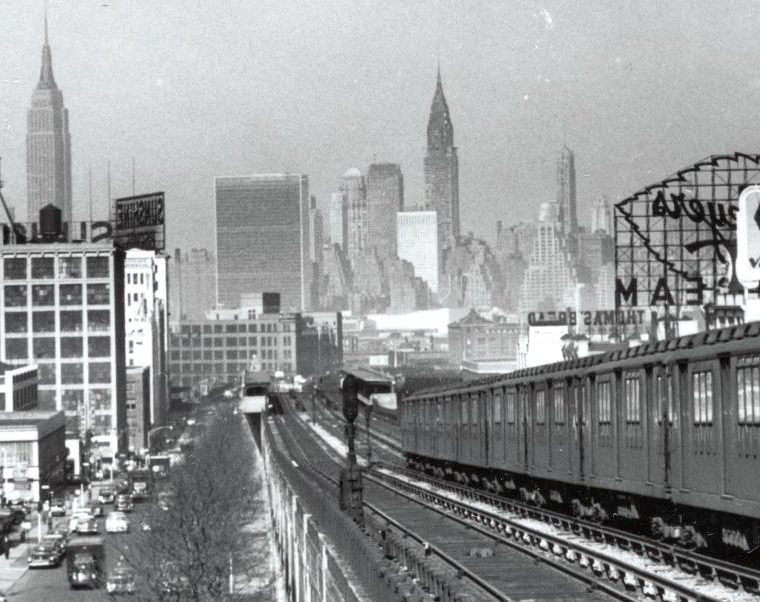

Max Hubacher, April 9, 1954, has me reliving my childhood with “(Queens, N.Y.) Subway and Manhattan’s skyline.”

That was the 7 train in 1954 and still is today, the IRT line running from (then) Times Square to Flushing. All of the line but the far west end is in Queens; all of the line but the Manhattan portion, the first two Queens stations, and the Flushing terminus is elevated. A chunk of the western part of the Queens portion runs over Queens Boulevard on a fancyish viaduct of concrete-encased steel. That stretch of the street is straight, and you see the result here: a wide street in two portions – eastbound and westbound – separated by the train. East of the straight run, the tracks curve a bit to follow Roosevelt Avenue; west of it, they curve to follow the boulevard to Queens Plaza, and then a big S curve into the tunnel heading to Manhattan.
From Queens Plaza to Flushing, the line has three tracks, and express trains run on the center track only in the direction of the rush. We’re looking at an express heading to Flushing, so this is the afternoon.
The old subway cars had narrow cabins for the drivers: you see the driver’s window to the left of the “7” sign, and the whole cabin was the width from the left side of the car to the door frame. That mean that the window in the center door faced the inside of the car and anyone – but most often a child – could stand there and watch the trip with the same view as the driver. I have no idea how many times I did that between 1970 (when I was tall enough to see through the window) and 1982 (when I moved out of Flushing). Several hundred, maybe? I wouldn’t be amazed to find out it was over a thousand: I commuted to school for six years on the 7 train, and watched out that window on the way home a lot.
In other words, this fairly anonymous photo is, for me, as familiar as home can be. The thing of it is that for any of the photos in the Hubacher collection at the NYPL, or any similar collection, there’s someone with similar memories. It’s not that I particularly love that viaduct, just that it’s permanently engrained in my head. When people involved in preservation talk about community and the built environment, this is part of what we mean: we learn the appearance of a place, the feel of it, and notice when it changes. Living in New York, you get used to the built environment changing, but not all of it, not all at once. If – and this is not going to happen in this century, so it’s a good hypothetical – the MTA were to tear down the elevated 7 train and replace it with a four-track subway, it would be an all around improvement: more capacity, better service, less above-ground blight. But a small part of me would mourn the loss of a piece of my past.
Re the title: I’m no Proust.

You must be logged in to post a comment.