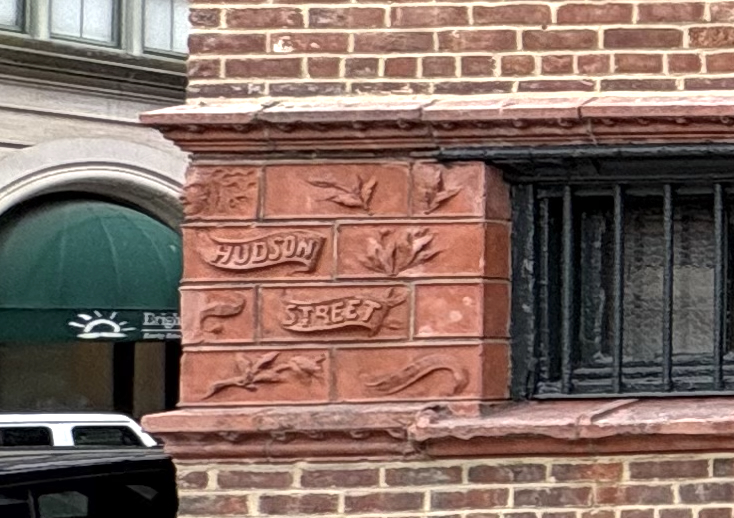

I doubt I’ll ever run out of blog fodder because of what happened with this photo:

I’ve walked by 135 Hudson Street many times, but I finally remembered to take a picture. You don’t see something like this every day. The simple facts: it’s a warehouse completed in 1886, facing the St. John’s Park freight terminal of the New York Central Railroad. It’s been converted to apartments and the freight terminal has been converted to the exit plaza from the Holland Tunnel, but the exterior of the building has barely been changed. Here it is in 1940:

The designation report for the Tribeca West Historic District has this fascinating quote from Montgomery Schuyler: “no style which yet has style.” In the forty years following the construction of this building, “no style” would become a compliment and the basis for a lot of modernist architectural philosophy. But I want to talk about structure and construction…
Here’s a close-up of one end of the arch over the Hudson Street entrance:

In no particular order, we’ve got a thick brick wall laid in common bond, an old and rusted tin sign with the address, a terra cotta decorative lintel hiding (probably) a cast-iron lintel, a four-course brick arch, and (painted black) a cast-iron transition bracket. It’s that last piece that’s unique and fascinating.
That cast-iron bracket has to deal with some complex geometry. The vertical pier above the bracket is a normal rectangle in plan. The pier below the bracket has a large-radius rounded corner, apparently to minimize damage from wagons entering, in lieu of a bollard. And the entry arch is coming in at roughly a 45-degree angle to horizontal. It is possible to bridge between those three geometries using masonry – that’s what the ancient art of stereotomy is about – but it’s difficult. A lot of the technological changes in construction materials can be explained by builders looking to replace techniques that require a lot of skilled labor using traditional materials with new techniques that reduce the skilled labor on site by using more advanced materials made in a factory. In this case, a very complex iron bracket replaced the masonry skill necessary to make that geometric transition. The iron, of course, is a manufactured object that took skill to make, but it’s the difference between craft and industry that stands out here. The foundry that made these brackets could have made a hundred more identical ones in a matter of days.
So we have a building with notably unornamented facades constructed using new technology. After 1900, that description would be attached to a lot of capital-M Modernist buildings.

You must be logged in to post a comment.