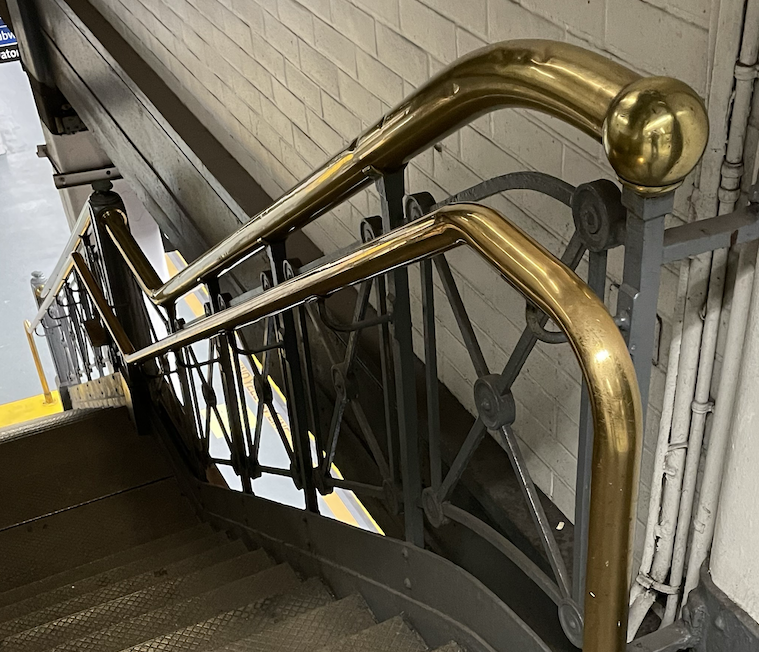

I don’t think I’ve used this picture before.

When we say New York’s “Pennsylvania Station was demolished in the 1960s” we’re obviously lying/exaggerating/obscuring. Penn Station is there! It serves half a million passengers every work day! So, what do we mean by “Penn Station”?
There are the platforms for the long-distance and commuter-rail trains coming from east and west (and, as of 1991, some from the north). Those are still there, as built between 1900 and 1910, and hardly changed in general form. The headhouse – the building above the platforms – was demolished in the 60s. The adjacent subways, built after the station itself, are there, with some changes in how they connect to the station. And the overall layout has not changed, even as a new concourse was built underground, below the new Madison Square Garden arena over the site. The addition of Moynihan Hall, in the post office across Eighth Avenue, expanded the layout but did not change the older portions of it.
If you want to see original pieces of Penn Station, it’s easy. Look at a platform, and look at the structure above the platform that used to support the concourse of the old headhouse and now supports the new concourse. But all that stuff is, for want of a better word, boring. Concrete floor slabs and steel floor beams. Even structural engineers think that stuff is boring and we design it. What everyone secretly (or not so secretly) wants to see is a piece of the beautiful original headhouse that somehow escaped demolition. And…on this stair from the lower concourse to a platform, look at that brass handrail (the upper one) and the wrought-iron work supporting it.
Credit where due: the lower brass handrail is a much more recent addition, in order to have a rail at the modern prescribed height, and someone did a nice job of matching the older rail.

You must be logged in to post a comment.