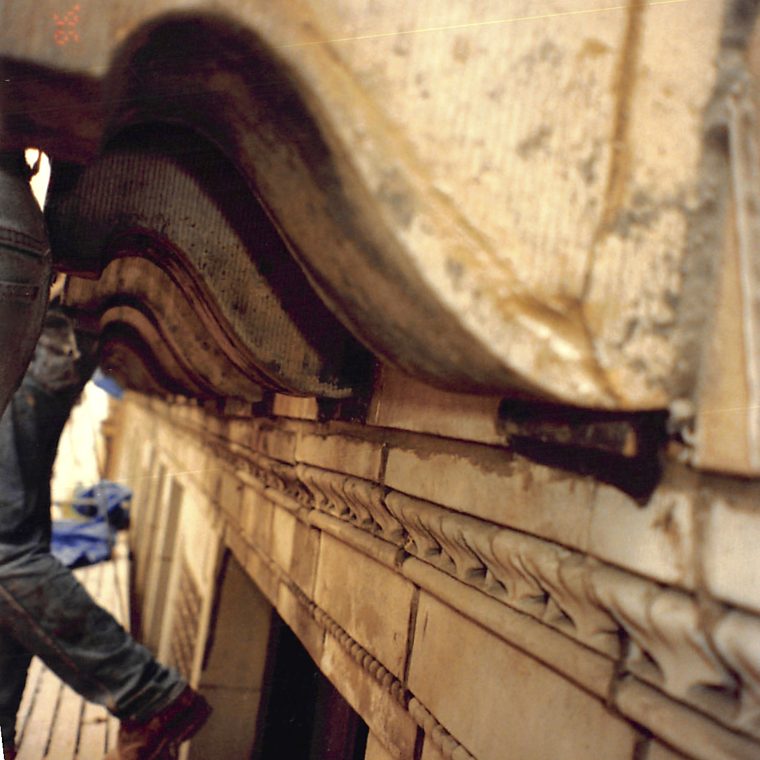

That picture shows the condition of a terra-cotta cornice on a steel-framed apartment house that I was examining some 23 years ago. You can’t see the cornice proper, which is above the frame of the picture; the big curved piece of terra cotta that occupies most of the shot is a decorative bracket below the cornice. These brackets, despite their name, are non-structural: they are part of the architectural language of the cornice. How non-structural are they? Here’s a look at what happens when you remove one:

That cartoonish hook is what held the bracket in place. The hook (somewhat rusted in this case) is hanging from a steel outrigger – a small cantilever beam that is supported by the frame of the building and sticks out to carry the cornice terra blocks above (you’re looking at their bottoms on either side of the outrigger) and the bracket block below. You can also see that the terra cotta, despite its appearance of being imitation stone, doesn’t extend very far into what is basically a brick wall.
Terra cotta veneer and ornament has been one of the more difficult problems with old high-rise facades. This is not because it’s a bad material, as it actually weathers better than a lot of natural stones. The problems inevitably involve rusting supports (as at this cornice) or poor detailing that created stress concentrations in the blocks. This raises the question of why? Why do we have this condition in buildings constructed between 1890 and 1930 but particularly in the 1910s and 20s?
It takes time for all the bugs to be worked out of a new technology. What was going on in that period, roughly 100 years ago? Steel skeleton technology was brand new in 1890 and still being developed through the 1910s. Ditto for masonry curtain walls, which got steadily thinner as their development diverged from bearing walls in the 1890s. The use of architectural terra cotta was slightly older, but the material had been used for some time as one-for-one substitution for stones. The idea of treating it as a lightweight material to be hung from steel was new circa 1900 and the details to do so (including both the masonry itself and the secondary steel framing that carries it) were being developed through the 1920s.

You must be logged in to post a comment.