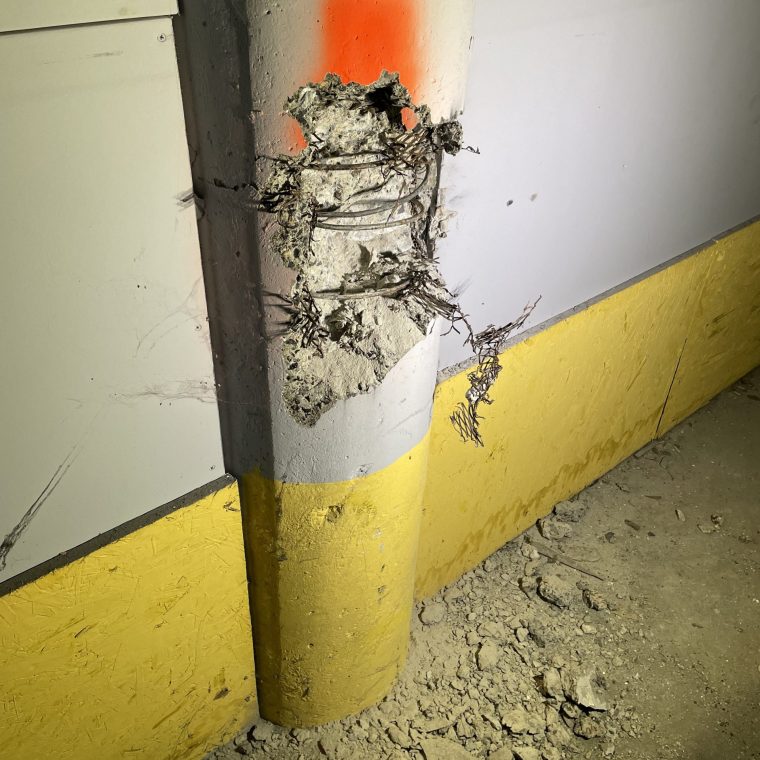

When I mentioned some of the odd columns designs that used to be allowed, I said that I had seen examples of all of them. As it happens, I saw another example yesterday and it seemed worth discussing. The badly-framed picture above shows a probe at a round concrete column in a circa 1910 industrial building. The concrete cover has been removed exposing ties and showing no longitudinal bars. I’ve copied the diagram I showed before below; the photo above corresponds to figure 80.

Putting aside the “I told you so” aspect of this, it’s worth discussing why the best engineers of the era thought that something like this might be okay. From our perspective today, a column without longitudinal bars is far too weak (because it has only the low-strength concrete of 115 years ago to resist load), has no useable capacity in bending (because it has to rely on the unreinforced core, and concrete failure in tension is unpredictable and brittle), and has no continuity and therefore no resilience. Sounds terrible, right? All of those concerns are the product of the years since this idea was in use, and specifically the product of empirical experience and dedicated research into the behavior of concrete structures. So our perspective is based almost entirely on hindsight.
Keeping in mind that the proper way to analyze reinforced concrete was still open to discussion after 1900, let’s try to look at this from the perspective of the people involved at the time. At its worst, concrete is a form of masonry that does not need separate mortar. A lot of old codes treated it that way, giving allowable stresses for concrete right next to the allowable stresses for brick and stone. In that case, why would any reinforcing be required? No reinforcing was required for masonry. Unlike brick, it is relatively easy to reinforce concrete, so that was seen at first as a useful but not necessary idea. Continuing along that path of logic, putting longitudinal bars into a concrete pier (figure 79) would increase the compressive resistance because the steel is both stronger and (on a unit basis) stiffer than the concrete. Today we would say that those bars are liable to buckle outward and so they don’t help unless that buckling is prevented (by using both longitudinal bars and ties, as in figure 81), but we know that based on experience and experimentation. The compression structural elements that people were familiar with at that time – wood posts, steel columns and struts, masonry piers – didn’t act that way.
Early research showed that unreinforced concrete columns tended to fail in shear, with material pushing out diagonally from the centerline of the columns. Providing central confinement in the form of steel ties (figure 80) reduced the severity of that mode of failure and increased the load at which it took place. So it made sense to have an option of ties with no longitudinal bars.
When you’re looking at the changes to any given technology or technological system, you have to try to put yourself in the mindset of the people working with it in the era that is of interest. They did not know what would happen later and they did not have the history that we rely on when we write codes and otherwise regulate that technology. Their view looking forward and ours looking back may be wildly different, as is true with this example.
You must be logged in to post a comment.