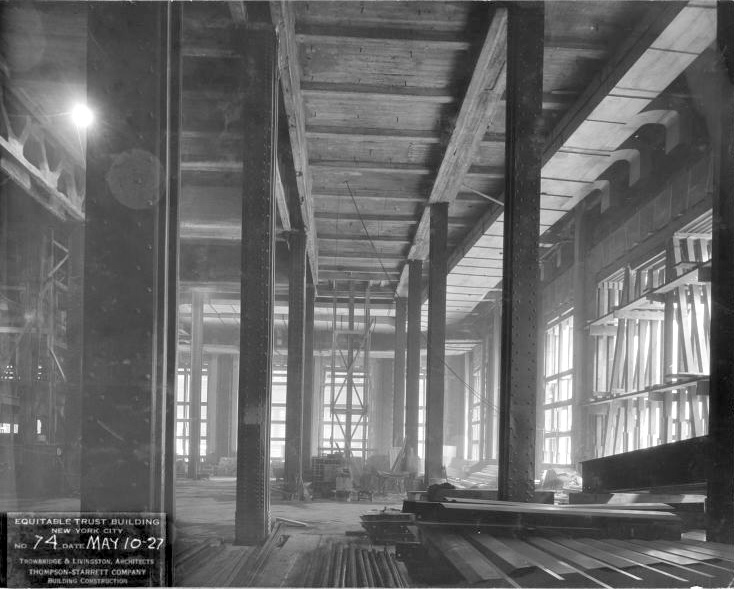

This series of blog posts may end up taking longer than the actual construction of the Equitable building, but I feel like it’s not often we get to see such thorough documentation of the construction technology of a moment in time. I’m going to switch gears today from the exterior views used so far for demolition, foundations, frame, and facade, to take a look at the interior in the early stages. The following photos show what was going on inside the building before the frame was topped out in the summer of 1927.
First up, the second-floor with its very high ceiling, when it was just raw concrete and steel. The column fireproofing masonry had not yet been built, and we see the steel beams and girders encased in concrete.

A similar view of the cellar. Ordinarily I’d assume that “vault” meant a sidewalk vault, an extension of the cellar below the street, but in this case it almost certainly means an actual vault to protect the various preciouses of the Equitable Trust Company.

Boilers in that era were massive cast-iron structures that had to be built within the building.

The electrical-conduit homeruns in the cellar were barely more delicate than the boiler:

Finally, the first floor. I’m not sure why there was scaffold there so late in the work, unless it was to create ornate interiors for the retail spaces.

Part 1: here.
Part 2: here.
Part 3: here.
Part 4: here.
Part 5: here.
Part 6: here.
Part 7: here.
Credit for the photos: The Miriam and Ira D. Wallach Division of Art, Prints and Photographs: Photography Collection, The New York Public Library. “Equitable Trust Company Building” The New York Public Library Digital Collections. 1927.

You must be logged in to post a comment.