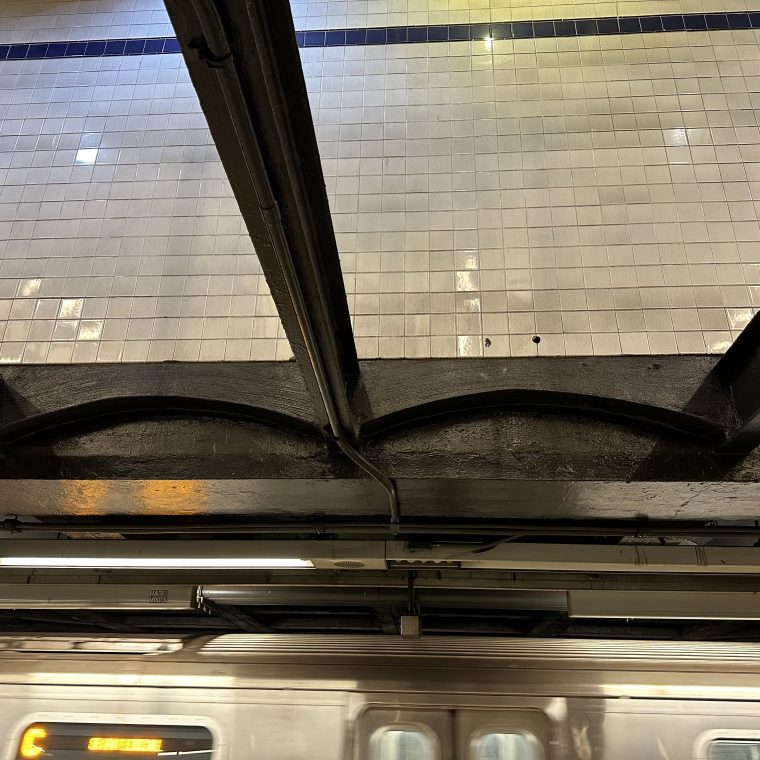

The picture above, from the Canal Street station on the IND, serving the A, C, and E trains, perhaps needs a little explanation to be clear. The tile wall at the top is closer to me than the train below it; there’s a mezzanine behind that wall (above the train), and the black-painted steel beams above me are carrying the floor of the mezzanine. The edge of that floor is visible as the scalloped concrete below the tile.
The reason I took this picture is that it’s one of the few places I know of where you can see the way that much of the original structure of the pre-World War II subway was built. The tunnel walls and roofs, and many of the interior floors (like this mezzanine) are framed with steel beams. The infill between the beams is concrete vaulting, like the low-rise barrel vaults seen here, with not much (sometimes no) reinforcing.
When the first IRT subway was built, between 1900 and 1904, it could be argued that reinforced-concrete was still in its infancy, particularly in New York, where it was competing with well-entrenched steel interests, but by 1932, when the Canal Street station opened, that was no longer true. So why concrete vaulting rather than simple reinforced-concrete slabs?
Vaults are stronger, which might have influenced the design of the underground roofs and exterior walls, which are subject to high loading from earth pressure. But I doubt that was decisive. People were designing concrete factories before 1910 for 300 psf or more live loads on the flat-slab floors. The bigger issue was longevity. Despite what many people think, ground water enters the tunnels and stations all the time, just to be pumped back out again. When stations flood, it’s typically because there’s a local increase in water inflow (from a broken water main, or from fire-fighters dealing with a particularly severe fire.) Waterproofing the structure itself has always been a prime concern: water that gets past the buried structure can be pumped out, but water that’s inside the structure may damage it. The outside faces of all of the buried structures are waterproofed, of course, but the less metal there is in the concrete, the less there is to rust.

