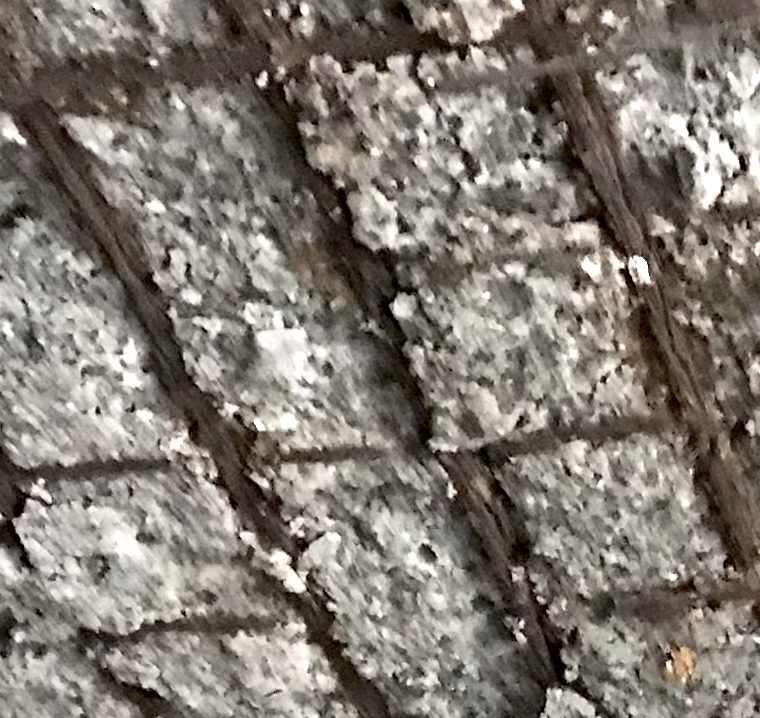

From 2018, a nasty surprise after the ceiling was removed:

More specifically, the gypsum board ceiling that had been put in place below the original plaster was removed, exposing the plaster, and the failure of the plaster, and the failure of the bottom of the cinder-concrete slab, and the failure of much of the wire-mesh reinforcing. The short version: the roof terrace above leaked, and the rusting mesh spalled the slab and plaster. Obviously installing a new gypsum-board ceiling had solved the problem.
The more interesting question is: why didn’t more bad things happen? Or, why wasn’t there a visible collapse? There’s no one answer to that question, but rather a bunch of partial answers which more or less get added together. First, despite appearances, the wire mesh wasn’t completely rusted: there was still some viable steel there. Second, the old designs for catenary slabs undercounted the strength of the steel, limiting wire tension to 20,000 psi when the material used could be loaded, with a safety factor, to 25 or 26,000. Third, the actual load on the terrace probably never got close to the 40 psf design live load used.
Finally, we should always have a safety factor in design, but in looking at a past non-failure, there is always the possibility that the safety factor was used up by circumstance. In other words, if the design allowed for loading that would stress the wire to its safe limit, the safety factor would be 1.0 (actual strength divided by required strength). Design safety factors are often in the 1.5 to 1.7 range, but if the actual strength is reduced by damage, the safety factor can decrease without anything obviously going wrong. As long as the remaining, reduced strength is greater than the required strength (in engineering-speak, as long as capacity exceeds demand) no collapse will occur. The required strength (the demand) changes over time with changes in load; the actual strength (the capacity) is supposed to be constant but in a case like this is gradually decreasing as the wire rusts.
Add those four factors together, and maybe it’s not so surprising that the slab didn’t collapse, but someday it would have. As the wire continued to rust, they would eventually have not been strong enough to carry the actual loads imposed. And then very bad things would have happened.


You must be logged in to post a comment.