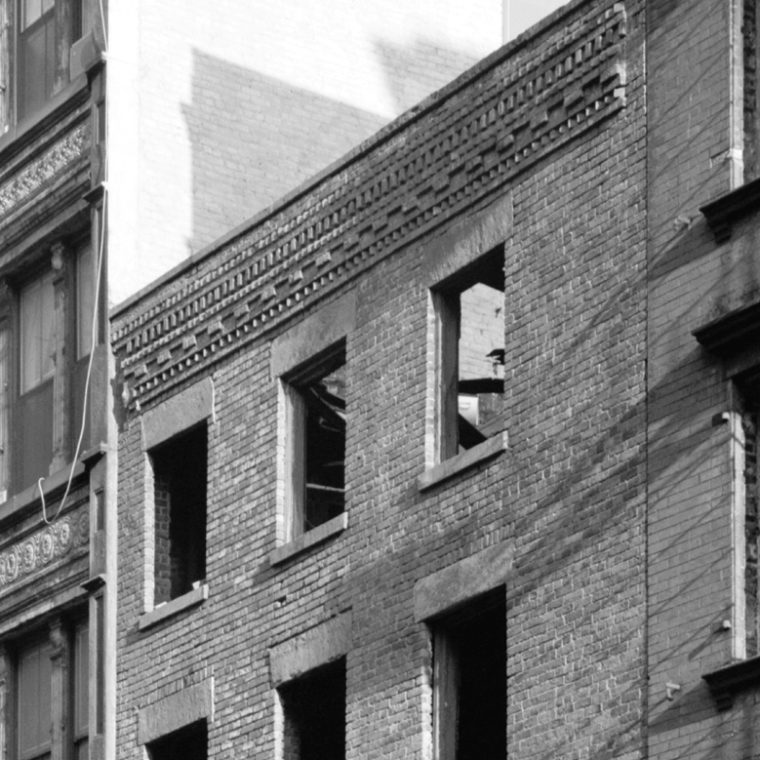

Our last pre-revolution building, for the last day before July 4, 2026, is one that just made it before the construction cut-off date of July 4, 1776: 273 Water Street was constructed in 1773. This is a house, built for Joseph Rose, used by him and his family until 1807, and with many owners, uses, and alterations after that. The original house was mostly wood-frame, with a brick front facade and a gable roof. The biggest alteration was after a fire in 1904, when the gable was removed and two stories added. That’s probably also when the rear wall was rebuilt as brick. It burned again in the 1970s, and sat empty until restored in the 1990s as part of the redevelopment of the South Street Seaport area. I should note that we never worked on it, but have worked on eight of its immediate neighbors.
The building is commonly mentioned as among the oldest in Manhattan, but we’re into Ship of Theseus territory. At best, original material includes portions of the front facade, some of the foundations, maybe some of the side walls, maybe some of the first and second floor framing. Ownership has changed repeatedly; use has changed repeatedly. I’m not saying this to argue for demolishing the building or to disrespect its history. In the US, we’re not very good about dealing with the gray areas of preservation. This series began with me pointing out the same problem with Fraunces Tavern.

As the finale of the series of posts, it should be noted that relations between the American colonists and England were strained long before 1776. There had been a running low-grade fight in New York between the Sons of Liberty – a sometimes-violent revolutionary group – and the local authorities starting in the mid-1760s. When Rose built his house, he could not have known the future, but his present was within the beginning of a political upheaval that included occupation of the city by a hostile army from 1776 until 1783.
Part 1, Fraunces Tavern: here.
Part 2, St. Paul’s Chapel: here.
Part 3, Fort Ticonderoga: here.
Part 4, Philipse Manor Hall: here.
Part 5: Vander Ende-Onderdonk House: here.
Part 6: Roslyn Grist Mill: here.
Part 7: Connetquot Mill: here.
Part 8: Flushing Friends Meeting House: here.
Like this? Then read the “Witnessing the Revolution” series by Cirrus Structural Engineering
You must be logged in to post a comment.